
You walk out of church on Sunday full — and by Wednesday, you can barely remember the main point. If that’s you, you’re not forgetful or unspiritual. You just haven’t had a simple place to catch what you’re hearing. Here’s the method I’ve used for years to actually remember Sunday’s message and carry it into the week.
Why sermon notes are worth taking
Taking notes does two things at once. It keeps you present and focused while the pastor is speaking, and it gives you something to return to later — so the sermon that moved you on Sunday actually makes it into Monday, Tuesday, and the rest of your week. Over time, your notes become a record of what God has been teaching you, one week at a time.
What to write down during a sermon
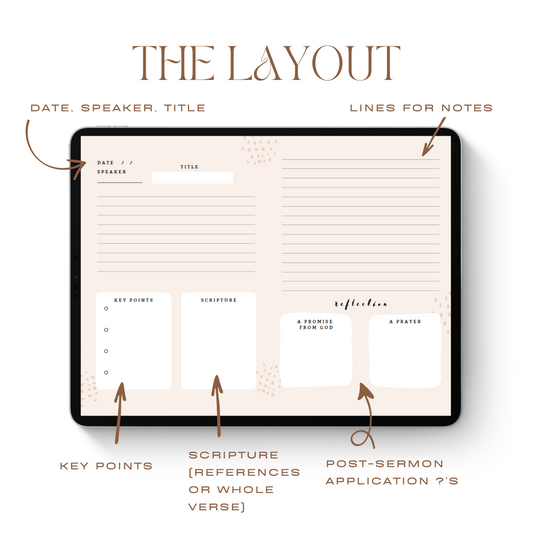
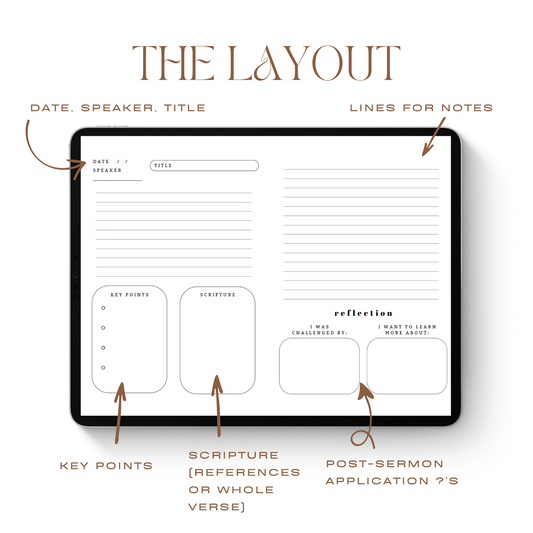
You don’t need to capture every word. A useful sermon-notes system usually gives you room for:
- The date — so you can look back later.
- The speaker — your pastor, a guest, or a conference session.
- The sermon title or theme — the big idea in a few words.
- The main Scripture references — the passages the message is built on.
- The key points — the 2–4 things you don’t want to forget.
- Your own notes — anything that stood out, convicted, or encouraged you.
- Reflection & application — one way to actually live this out this week.
That last line matters most. Notes you never apply are just notes. A single, specific application is what turns a sermon into growth.
A simple method anyone can follow
If you’re just starting, try this: at the top of the page, write the date, speaker, title, and main passage. Down the left, jot the key points as the pastor moves through them. Leave the bottom of the page for one reflection and one thing you want to do about it — a prayer to pray, a person to forgive, a verse to memorize, a habit to start. Keep it light. The goal is remembering and applying, not transcribing.
What to do with your notes during the week
Open them once midweek. Read your one application and ask, “Did I do anything with this?” On Saturday, glance back before the next Sunday so you walk in with last week still fresh. This tiny rhythm — Sunday, midweek, Saturday — is what makes the message stick.
Digital vs. paper sermon notes
Both can work. Phones are convenient, but for a lot of people a notes app becomes a graveyard — the notes are technically saved and never seen again. Writing by hand slows you down just enough to actually process what you’re hearing, and a journal on your shelf is far easier to return to than a buried file. If you take notes on your phone, build in a weekly review so they don’t disappear.
Taking sermon notes as a group
Sermon notes are even better shared. If your small group or ministry wants to walk through Sunday’s message together, our church & group orders make it easy to get everyone the same guided journal, with savings on 10 or more.
A note from me
I started writing down sermon notes at the end of high school, in a season of uncertainty, because I wanted a place to remember what was true. Those pages became a record of God’s faithfulness I still look back on. That’s the whole reason I designed a guided journal around this exact method.
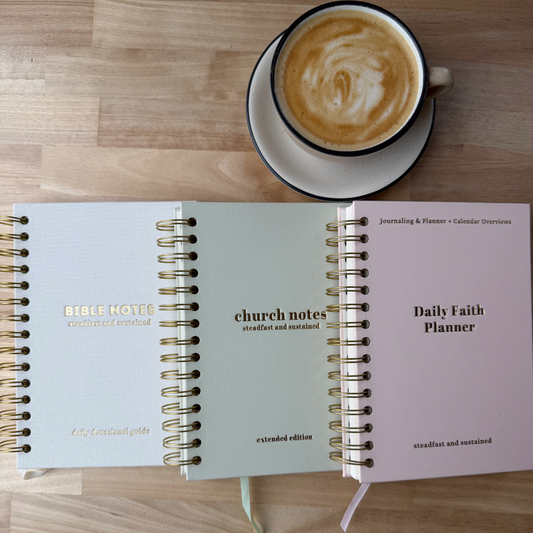
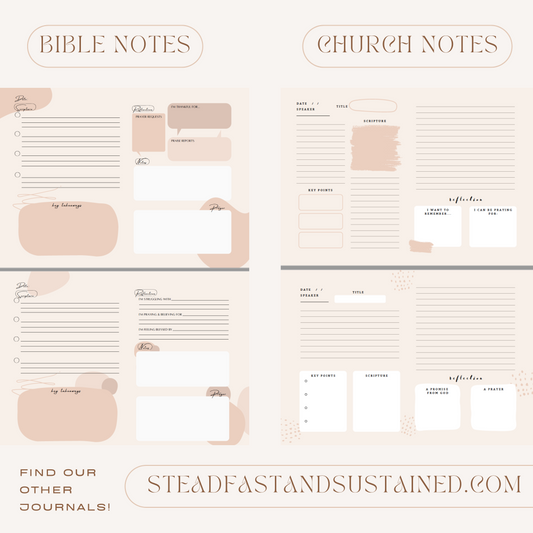
If you’d like a simple place to do all of this, our Church Notes Journal gives you a guided page for every part above. For heavy note-takers there’s the Extended edition with four pages per sermon, a grab-and-go Church Notes Notepad for travel and small groups, and the full Church Notes collection if you want to compare sizes and covers.